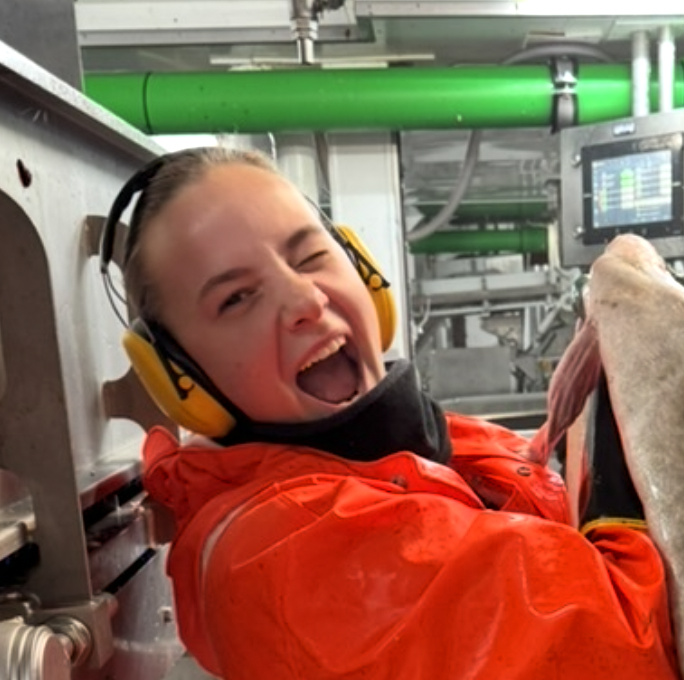
Martine Støversteen Johansen
MSc student at the Norwegian College of Fishery Science, UiT The Arctic University of Norway
Contact
Martine Johansen, an MSc student at the Norwegian College of Fishery Science, took part in a research voyage on the trawler Hermes in November. Here is her story from five weeks in the Barents Sea.
The origin of the voyage
I am deeply concerned with the need to address the problem of marine plastic pollution, as plastic in the ocean is harmful to nature in general and may also affect our important fisheries and marine ecosystems. For this reason, I wanted my master’s thesis to focus on this issue and chose to investigate possible alternatives to traditional chafing mats made from petroleum-based plastics.
This gave me the opportunity to participate in a five-week voyage with Hermes in the Barents Sea, including periods around Bjørnøya (Bear Island), Svalbard, and near the Norwegian coast. During the trip, experimental mats were tested under normal operations in real fishing activities. Throughout the voyage, I conducted regular observations and sampling, and systematically documented wear and tear through consistent logging of trawl hauls, photography, and assessment of material changes over time.
Conventional chafing mats
Chafing mats consist of bundles of thin strands made from polyethylene (PE) and polypropylene (PP). These mats protect the codend of bottom trawls from wear, damage, and potential loss of catch. However, while providing protection, chafing mats also contribute to plastic pollution in the ocean when strands wear off during use.
This results in microplastic pollution, and it is not uncommon to find thin, colored plastic threads along the shoreline that may originate from chafing mat bundles. To test alternative materials, experimental wear mats were produced combining traditional chafing material with a biodegradable plastic material and “plates” made from cowhide. Cowhide was commonly used as trawl mat material up until the 1980s.

A workday on board: trawl deck, factory, and scientific structure
Daily life followed a watch system of six hours on and six hours off. For me, this meant varied tasks and a steep learning curve: time spent on the trawl deck, time in the factory, and time allocated to note-taking, data processing, and thesis work.
On the trawl deck, I gained insight into work that demands practical skills, pace, and constant attention, where safety and teamwork are critical. I participated in repairs and maintenance, learned to splice rope and wire, mend gear, and followed the processes involved in setting, hauling, and emptying the codends. This gave me a clearer understanding of how much experience underpins good decision-making on deck, and how essential cooperation is for safe and efficient operations.
In the factory, I took part in production by feeding fish into the gutting machine, cleaning, sorting, and freezing fish into blocks that were packaged once fully frozen and stored in the freezer hold. I have previous experience from slaughterhouses and fillet factories on land, but working on board provided new insight into how efficiency, precision, and species knowledge must work together when the entire value chain takes place at sea, coordinated across two shifts and under changing conditions.
Between watches, I spent time organizing data and working on my master’s thesis, but also engaging in knowledgeable conversations in the mess, socializing, and playing board games with the crew. During the voyage, the Norwegian Coast Guard also came on board for an inspection, which I was allowed to observe. This provided additional perspective on the interaction between operations, regulations, and management.

Reflections
One of the most impactful aspects of the voyage was the crew. A modern vessel is a complex workplace, but daily life feels safe and motivating when the culture is characterized by clear communication, humor, respect, and a willingness to share knowledge. Life at sea can involve long days and challenging weather, but with openness and a willingness to learn, a welcoming and competent crew—one that prioritizes both knowledge sharing and social interaction—can make weeks on board enjoyable, fast-paced, and meaningful.
After five weeks, I am left with a much broader foundation of knowledge about fisheries, technology, and management, as well as valuable experience in how research can be carried out in a hectic everyday setting at sea. The ocean offered countless impressions, from spectacular skies to new species and observations for me—such as the realization that marine life is diverse, different, and creative, and that there really are “mice” (sea mice) and “leopards” (spotted wolffish) in the ocean. 😉

This journey became more than a data collection period. It became an experience from the Barents Sea centered on work, learning, and cooperation: a crew that keeps operations running under demanding conditions, day after day, far offshore, and a reminder that solutions for more sustainable fishing technology must be tested where they are actually used—through close interaction between research and industry.
A heartfelt thank you to the shipping company Hermes AS for making it possible for me to participate at sea and test materials under normal operations, and to the crew under the leadership of Captain Åsmund Breivik for such a warm and welcoming reception!

